
Everyone quotes the same number
A resolution rate is the figure everyone in this category quotes at everyone else, and it is close to the least interesting thing you can know about an agent. It is a claim about volume. It says nothing at all about the conversations that were not resolved.
The rest is where trust is won or lost. A customer who gets a fast, sourced, correct answer remembers nothing about it a week later. A customer stuck in a loop with something that will not admit it is stuck remembers that for a year, and tells people.
Where the rest actually goes
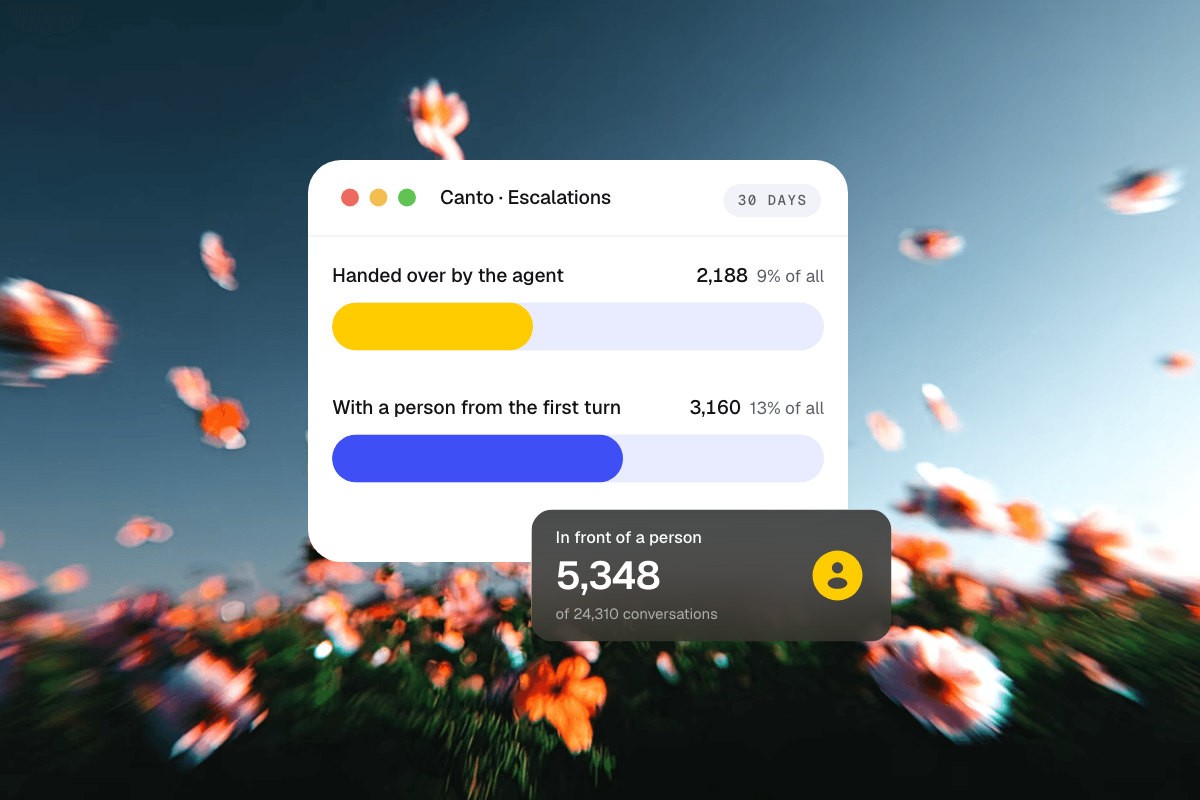
It is not one pile. Part of it is escalations the agent calls on itself, when it hits a guardrail or runs out of grounded answer. The other part was never the agent’s to take: the customer asked for a person in the first turn, or policy routed it to one.
The two halves want different metrics. The first is a quality signal, and an escalation rate that climbs means the knowledge is thinning or the guardrails have been set too tight. The second is a routing signal, and a routing signal should be boring.
What the person actually receives
A handoff that arrives as a raw transcript is not a handoff, it is homework. Ours carries the agent’s summary, the action log, the guardrail that fired and the customer’s own words. The person picks the thread up mid sentence instead of starting again, which is the whole difference between a handoff and a transfer.
A handoff is not the agent failing. It is the agent doing what no phone tree could: knowing the exact turn it stopped being the right thing to talk to.
Three numbers instead of one
So we stopped reporting one figure and started reporting three: escalation rate as a quality signal, time to a person from the turn the agent decided, and resolution after handoff. A handoff that does not resolve is a queue with an extra step in it.
What to do on your floor
Split the two halves before you report either of them, because an average of the two hides both.
Review the escalation rate every week and treat a climb as a knowledge problem before you treat it as a model problem.
Time the handoff from the turn the agent decided, because the customer has been waiting since then and not since you noticed.
Write the handoff the way you would want to receive it, with the summary and the action log ahead of the transcript.
None of the three numbers flatters the product the way a resolution rate does, and that is the point of them. A resolution rate is what the agent managed on its own. These are what happened to everyone it could not help, and that is the half a customer judges you on.


